
Reviewed · LISBON WALKING TOURS
Évora: Private walking tour with tickets to main monuments
Évora packs a remarkable amount of Portugal’s past into a walkable old town. In two and a half hours, you move from the Roman temple to the Gothic cathedral, the Chapel of Bones and Renaissance works, with a private guide to connect the stones to the people and events behind them.
I like two things in particular: the included cathedral and Chapel of Bones tickets, which make it easier to focus on the visit, and the private format, which lets you ask questions and shape the conversation. Guides named João, Paulo, Elsa and John are repeatedly praised for making history clear and personal. One consideration: the route covers many stops at a brisk clip, and you may want to return on your own to spend longer inside.
At a glance
- A private walk through Évora’s old town: Only your group takes part, so you can ask questions and discuss the parts that interest you.
- Two major admissions included: Your fee covers entry to the cathedral and the Chapel of Bones.
- A rooftop view: The cathedral visit includes its cloisters and roof, a useful way to get your bearings over the city.
- More than headline sights: The route also takes in Páteo de São Miguel, the Ladies’ Gallery at the former royal palace and a romantic setting known as Ruínas Fingidas.
- History told across centuries: Roman, Muslim, medieval and Renaissance influences all have a place on this walk.
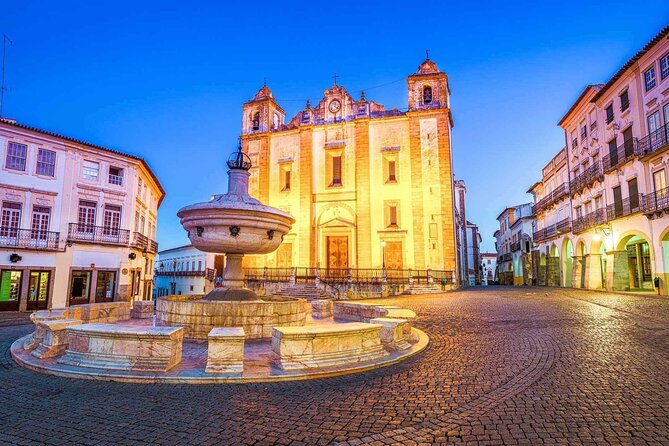
- A practical meeting point: Start and finish at the fountain in Praça do Giraldo, the city’s central square.
Start in Praça do Giraldo, Évora’s civic heart
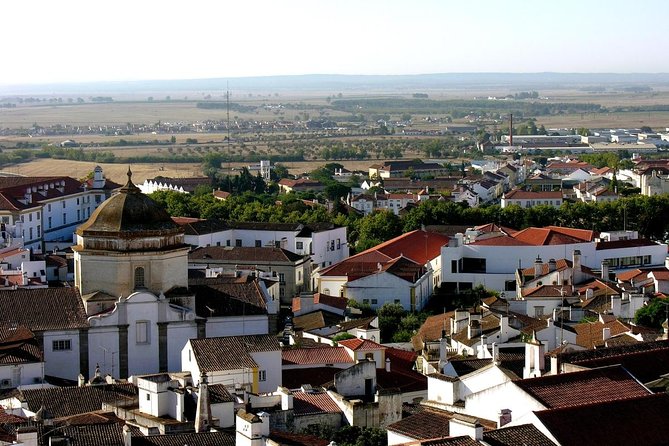
The tour begins at the fountain in Praça do Giraldo, a natural place to start exploring. Évora’s central square has long been a focal point of social, economic and political life. Your guide uses it to set out the city’s place in Portuguese and wider history, and to point out how local stories connect with events beyond Portugal.
The square also gives you a first look at the city’s layered character. It is not simply a pretty stop before the monuments. It helps explain how public life, politics and religion met here, including the darker history of the Inquisition. The tour pauses at a memorial to its victims and discusses the trials and executions associated with the square. This is a short stop, but it gives the city’s grand architecture a more human context.
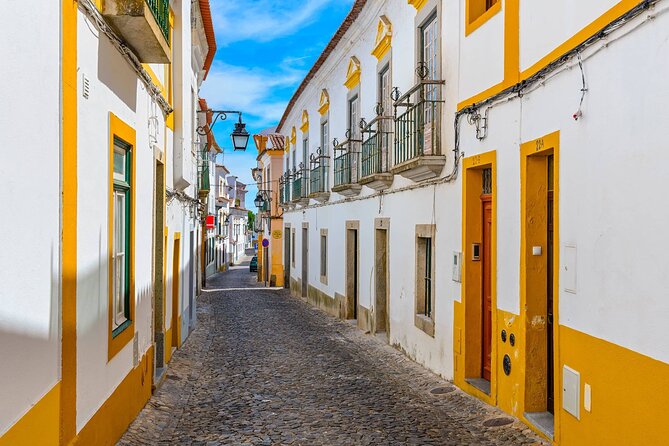
From here, you pass along a traditional shopping street lined with local crafts. Cork goods, pottery, painted furniture, chocalhos (rattles) and capotes (traditional Alentejo cloaks) offer a glimpse of regional traditions. There is no scheduled shopping stop, so treat this as a chance to notice what is made locally, rather than time set aside to browse.
More Évora and Alentejo trips in Lisbon:
- Évora and Megaliths Full-Day Tour from Lisbon
★ 4.7 · 456 reviews - Évora and Monsaraz with Regional Wine Tasting from Lisbon
★ 4.5 · 229 reviews - Évora (with Sé & Bones), Evoramonte & Arraiolos: From Lisbon
★ 4.7 · 57 reviews
Climb into the cathedral and its cloisters
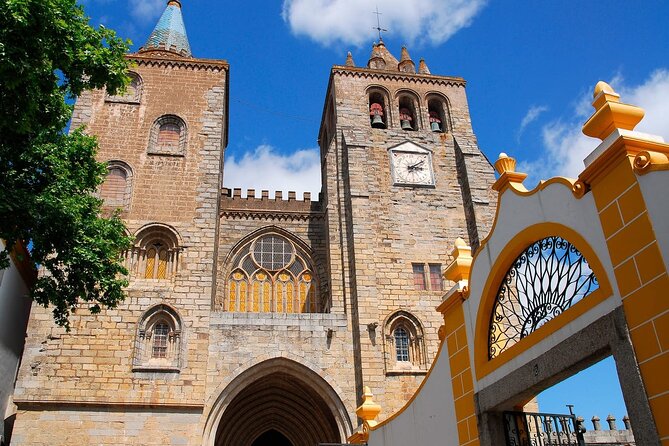
The Sé Cathedral is one of the tour’s main visits. It is described as Portugal’s largest Gothic cathedral, and its design recalls Notre-Dame in Paris. Inside, your guide points out architectural details and references to earlier pagan traditions that may not be obvious in a first walk through a Catholic church.
The included admission covers the cathedral, cloisters and roof. That last stop is especially useful: the elevated view gives you a clearer sense of the old town’s scale and the pale buildings clustered beneath you. Set aside a little attention for the roof visit, not just the interior. It turns the city from a sequence of streets into a place you can read from above.
The scheduled visit is about 30 minutes, enough for an introduction rather than a long, unhurried exploration. If sacred architecture is a particular interest, you may want to return later and take more time. The value of having a guide here is that you can ask about details you might otherwise walk past, instead of trying to decode every feature alone.
Find Rome in the Temple of Évora
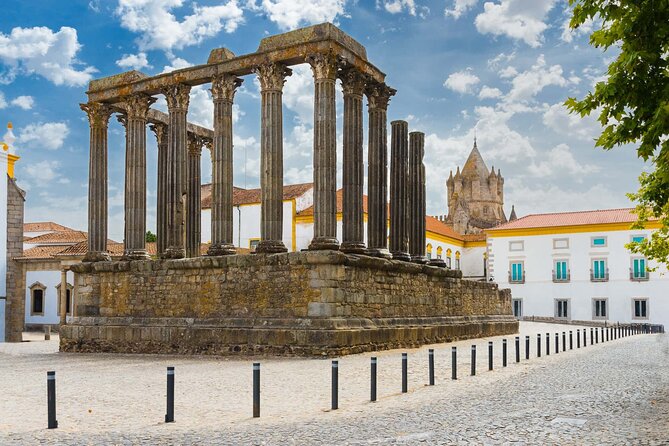
A short walk brings you to the Roman temple, often called the Temple of Diana. Its surviving columns are among the city’s most familiar sights, and they offer a striking reminder that Évora was important long before Portugal’s maritime age. The structure is described as one of the best-preserved and oldest temples of the Roman Empire.
The stop is brief, around ten minutes, and the temple is viewed without an admission ticket. That suits the site: the columns are visible in the open, while the guide supplies the context that a quick look cannot. You will hear about the monument’s long life and the ancient city associated with Julius Caesar.
This is a good moment to notice how close Évora’s different eras sit together. The Roman remains are not cordoned off from daily city life. They are part of the old town’s fabric, and the walk keeps moving between ancient traces and later buildings.
Step into the quieter Páteo de São Miguel
Páteo de São Miguel is one of the less obvious places on the route. This former fortified area was tied to the city’s governor and served as a residence for kings when they stayed in Évora. It is also linked to the religious and military Order of Évora, which later became the Order of Avis.
For you, this stop adds something that the major monuments cannot: a sense of how power was organized within the city. Its less prominent location also makes a welcome change from the headline sights. The visit lasts about ten minutes, so it is a compact introduction rather than an extended tour of the site.
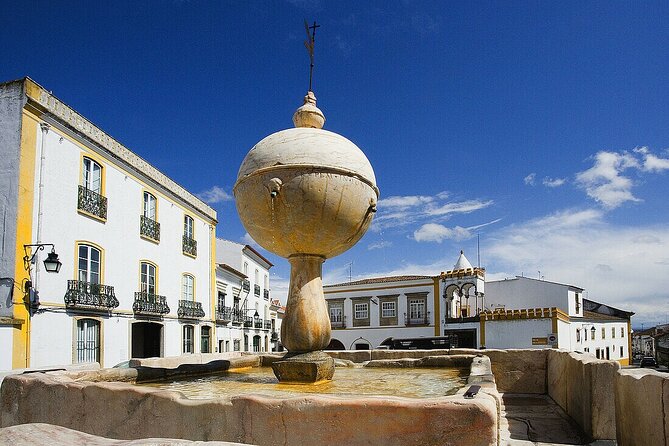
The guide may also point out a fountain associated with the city’s Renaissance period. Inaugurated in 1556, it is an early example of Mannerist art in Portugal and a statement of civic progress under Cardinal D. Henrique. It is the sort of detail that rewards a guide’s eye: a fountain can seem like street furniture until you understand its place in the story of the city.
More walking tours in Lisbon:
- Lisbon: History, Stories and Lifestyle Walking Tour
★ 4.8 · 10,902 reviews - Best of Lisbon Small-Group Guided Walking Tour
★ 5.0 · 4,869 reviews - Lisbon: Food and Wine Small Group Walking Tour
★ 4.9 · 4,082 reviews - Best of Lisbon Walking Tour: Rossio, Chiado & Alfama
★ 4.9 · 2,700 reviews
Read the Renaissance façade of Igreja da Graça
Igreja da Graça is presented as a major Portuguese Renaissance work, with Mannerist elements in its design. Its façade is the focus here, including the well-known figures nicknamed the boys of Graça. Your guide explains the stories and symbolism connected to the building and its former hermitage.
The stop is short, around ten minutes, but it offers a useful counterpoint to the cathedral. Instead of looking only for age or size, you can compare the changing tastes and ambitions expressed in Portuguese religious architecture. This is where a private guide’s explanations can make the walk feel less like a checklist and more like a conversation about how the city changed.
Face the Chapel of Bones, then visit São Francisco
The Chapel of Bones is the most unusual stop, and admission is included. Built in the 17th century, its walls are covered with human bones belonging to people who lived in Évora. The effect is deliberately stark. The chapel’s message is a reminder of mortality, and its setting has prompted legends and stories that your guide can explain.
You have about 30 minutes here, which is generous compared with several of the outdoor stops. The subject is macabre, but the point is not simply to shock. The chapel gives you a window into how earlier generations used religious art and ritual to confront death. If you prefer not to enter, keep in mind that this is one of the tour’s central visits.
Next comes Igreja de São Francisco, once known as the golden convent. The present church was built on the site of an earlier Franciscan convent and is noted for its architectural innovation. It also hosted royal weddings and baptisms tied to major turns in Portuguese history. The visit is brief, around ten minutes, but it helps connect religious buildings to the royal household and the politics of the time.
Look for the royal palace that remains
The nearby Palácio de Dom Manuel is part of a once larger royal complex. Today, the Ladies’ Gallery is the surviving section highlighted on the walk. Its 16th-century setting offers a more intimate pause after the imposing church and the Chapel of Bones.
The stop is about five minutes, so expect a quick introduction. It is useful to understand what once stood here, even if little of the old complex remains. The nearby Ruínas Fingidas provide a different kind of historical experience: a romantic arrangement assembled from elements and ruins of a 16th-century palace. Created in the spirit of the 19th-century Romantic movement, it is a picturesque place for a photograph and a reminder that later generations reshaped the past to suit their own tastes.
Follow Évora’s walls to the Aqueduct of Silver Waters
The walk also passes Évora’s defensive walls. They span several periods: Roman sections from the third and fourth centuries were reused by later peoples, including the Visigoths and Muslims; medieval walls followed in the 14th century; and later bastioned works were built and strengthened around the Napoleonic era. Rather than treating the walls as one structure from one moment, your guide can help you see how the city’s defenses changed with its rulers and military needs.
The final highlighted stop is the Aqueduct of Silver Waters, an 18-kilometre Renaissance work opened in 1537. Its arches are still part of the city, and houses built between them give it a distinctive look. The tour pauses for about five minutes, enough to appreciate the design and hear why it is considered one of Portugal’s most notable civil works of the Renaissance.
This last stop leaves you with a useful contrast. Évora’s story is not only about temples, churches and royal residences. It is also about the public works that carried water and supported life across the city.
What the private format and price are worth
The advertised price is $105.26 per person, with group discounts available. That is a meaningful cost for a walking tour, so the value depends on what you want from a guide. You are paying for a private experience, an English-speaking guide, and admission to two major sites, not just a route between outdoor landmarks.
A good guide adds context that is hard to get from plaques alone. The strongest praise for guides such as João, Paulo, Elsa and John focuses on clear explanations, humor, a relaxed pace and the ability to answer questions. Some guides have also offered restaurant, souvenir and onward-travel suggestions, and one helped with a winery booking. These extras are not guaranteed, but they show why it can be worth telling your guide what you care about at the beginning.
The tour is listed at about two and a half hours. Some guides may continue longer when questions and conversation keep the walk going, but plan around the stated duration rather than counting on extra time. Since meals are not included, you will need to arrange food separately.
Is this the right Évora walk for you?
This tour suits you if you want a broad introduction to Évora in one outing, especially if you value history, architecture and the chance to ask questions as you go. It works well for first-time visitors who want a guide to connect Roman, medieval and Renaissance sites, and for small groups who prefer a private conversation to a fixed group experience.
The route requires a moderate level of physical fitness. You will be on foot for much of the 2.5 hours, and the cathedral visit includes access to its roof and cloisters. Wear shoes you are comfortable walking in, and consider whether the Chapel of Bones is a visit you want to make.
I would book this walk if you want a strong orientation and a guide who can make the city’s monuments fit together. If you prefer long, independent visits at every site, use the tour as an introduction and leave time to return to your favorites. It starts and ends at the fountain in Praça do Giraldo, and free cancellation is available up to 24 hours before the start time.
FAQ
How long is the tour?
The tour lasts approximately 2 hours and 30 minutes. Some guides may spend longer answering questions, but the stated duration is approximate.
Is the tour private?
Yes. Only your group takes part in the activity.
What language is offered?
The tour is offered in English.
Which admission tickets are included?
Admission to Évora Cathedral and the Chapel of Bones is included. The cathedral ticket covers the church, cloisters and roof.
Where does the tour start and finish?
It starts at the Giraldo Square Fountain at Praça do Giraldo 7 in Évora and ends back at the meeting point.
Are meals included?
No. Meals are not included.
How far ahead is the tour usually booked?
It is booked an average of 52 days in advance.
More private tours in Lisbon
- True 4Hour Private Tuk Tuk Tour: Discover Lisbon with a Local!
★ 5.0 · 8,008 reviews - Lisbon: Private Guided Tuk-Tuk Tour with Hotel Pickup
★ 4.9 · 4,552 reviews - Lisbon Highlights: Private Tuk Tuk Tour Adventure Sightseeing
★ 5.0 · 3,284 reviews - Sintra Full-Day Private Tour – A Journey through Wonderland
★ 5.0 · 1,665 reviews
Lately reviewed in Lisbon
- Lisbon: Sunset and Wine Luxury Catamaran Cruise★ 5.0 · 17 reviews
- Lisbon Sunset Boat Tour with local Snacks & Drinks★ 4.9 · 11 reviews
- Lisbon: Street Art Tour★ 4.7 · 66 reviews
- Lisbon: Streets of Alfama Private Segway Tour 1.5hour★ 4.8 · 15 reviews
- Lisbon: Sunset Boat Party with 2 Drinks and Free Club Entry★ 3.9 · 93 reviews
- Tuk Tuk Lisbon: Street Art 2-Hour★ 5.0 · 6 reviews
- Lisbon 3-Hour Street Art Tour★ 4.6 · 63 reviews
- Lisbon Street Art Tour★ 5.0 · 4 reviews
Lisbon Walking Tours, compared.

Best of Lisbon Small-Group Guided Walking Tour
Read our review →
Best of Lisbon Walking Tour: Rossio, Chiado & Alfama
Read our review →

Sintra & Cascais Day Tour with Pena Palace Entry and Gardens Walk
Read our review →
Lisbon Roots – Small group Food & Culture Walking Tour w/tastings
Read our review →
Starter Walking Tour to the highlights in German
Read our review →Browse the lists this tour appears in